If you are shopping for a new AC or heat pump, SEER2 in California is the first number you will see on every quote. Since January 1, 2023, all new central air conditioners and heat pumps have been rated with SEER2, EER2 and HSPF2, the updated versions of the old SEER, EER and HSPF ratings. They measure cooling efficiency over a season, cooling efficiency on a hot day, and heating efficiency over a winter, respectively.
For Los Angeles homeowners, the practical answer is this: compare SEER2 numbers only with other SEER2 numbers, pay real attention to EER2 if you live in the San Fernando Valley or another hot inland area, verify the exact equipment pairing on an AHRI certificate, and buy higher efficiency where you actually run the system a lot. This guide explains each rating, what changed in 2023, how the Southwest regional rules affect California, and how to decide what is worth paying for.
What changed in 2023: SEER to SEER2
The Department of Energy updated the test procedure used to rate central air conditioners and heat pumps. The biggest change was raising the external static pressure used in testing. In plain terms, the old test assumed the equipment was connected to unrealistically easy ductwork. Real ducts in real homes, especially older LA homes with long, leaky or undersized runs, push back harder against the blower. The new M1 test procedure reflects that more realistic resistance.
Because the test is tougher, the same piece of equipment earns a lower number under SEER2 than it did under SEER. A system that would have been labeled with a certain SEER now carries a somewhat lower SEER2, even though nothing about the hardware changed. That is why you should never compare a SEER2 rating on a new quote with the SEER rating on your old unit or on an older brochure. It is an apples-to-oranges comparison.
At the same time, the DOE raised the minimum efficiency standards. Together, the new test and new minimums mean new equipment is both rated more honestly and required to perform better than the systems it replaces.
The three ratings: SEER2, EER2 and HSPF2 in California homes
| Rating | What it measures | Why it matters in LA |
|---|---|---|
| SEER2 | Cooling efficiency averaged across a range of outdoor temperatures over a typical cooling season | Best overall indicator of how much electricity cooling will use over a year; matters most for homes that run AC for many months |
| EER2 | Cooling efficiency at a single hot outdoor temperature at full load | Reflects performance on peak afternoons in the Valley, Burbank and Glendale, when electricity demand and time-of-use rates are highest |
| HSPF2 | Heating efficiency of a heat pump over a heating season | Useful for comparing heat pumps; less decisive in mild LA winters than in colder climates |
SEER2: the season-long number
SEER2 is a weighted average. It gives credit for how efficiently the system runs at mild and moderate temperatures, which is where systems spend most of their hours. Variable-speed and two-stage equipment earns high SEER2 numbers because it can slow down and sip power on mild days rather than running full blast and shutting off.
EER2: the hot-afternoon number
EER2 is measured at a single, hot outdoor condition with the system running at full capacity. That is very close to what a Valley home experiences at 4 p.m. in late August or during a September heat wave. A system can have an impressive SEER2 driven by great part-load performance but a more modest EER2. If you live somewhere hot, EER2 tells you how the system behaves when it matters most.
HSPF2: the heating number
HSPF2 measures how efficiently a heat pump heats over a season. LA winters are short and mild, so heating is a smaller share of annual energy than in most of the country. HSPF2 is still worth comparing between heat pumps, especially if you are replacing a gas furnace with a heat pump, but it rarely drives the decision here.
Why EER2 matters on hot Valley afternoons
The San Fernando Valley, Burbank, Glendale and much of the inland LA area regularly run far hotter than the coast. On those afternoons, the AC runs flat out for hours. That is exactly the condition EER2 describes.
Three reasons this matters to you:
- Peak pricing. LADWP, SCE, Burbank Water and Power and Glendale Water and Power all have rate structures where late-afternoon and early-evening electricity can cost more. The hours your AC works hardest often line up with the most expensive power.
- Grid stress. Heat waves push the grid hard. Equipment that stays efficient at high temperatures reduces load when it matters most, which is a big part of why California cares about EER2.
- Comfort at the extremes. A system with good high-temperature performance is more likely to keep up during a heat wave without struggling.
Southwest region rules for California
Under the federal standards, the country is split into regions. California is in the Southwest region, along with Arizona, Nevada and New Mexico. The Southwest has higher minimum efficiency requirements for central air conditioners than the North, and it adds an EER2 requirement on top of SEER2. That reflects the hot, dry conditions where peak cooling efficiency matters most.
What this means for you, practically:
- Any new central AC installed in California has to meet the Southwest regional minimums. A legitimate contractor will only quote compliant equipment.
- Some lower-tier AC equipment that is legal elsewhere may not be allowed here, which narrows the cheapest options.
- Heat pumps are covered by national minimums for SEER2 and HSPF2; the regional split applies mainly to central air conditioners.
- Exact minimum numbers and the details by product type and capacity are set by the DOE. Rather than rely on a number you read online, verify that the specific matched system you are being quoted is compliant.
Separately, California's Title 24 Part 6 energy code governs HVAC changeouts, including HERS verification for refrigerant charge, airflow and, when ducts are altered or replaced, duct leakage. A high-efficiency system installed with a bad charge or poor airflow will not deliver its rated efficiency, which is why those tests exist. Our guide on AC replacement permits in Los Angeles explains how that works.
Planning a new system? Get a free in-home estimate with a load calculation and a written quote with exact model numbers. Call (818) 230-4038 or use the form — or text us a photo of your current system.
How to read the AHRI certificate and EnergyGuide label
The AHRI certificate
Here is something many homeowners do not realize: a split system's efficiency rating applies to a specific matched combination of outdoor unit, indoor coil and, often, furnace or air handler. The same outdoor unit paired with a different coil can carry a different rating. The AHRI (Air-Conditioning, Heating, and Refrigeration Institute) Directory lists rated combinations.
To check a quote:
- Get the exact model numbers for the outdoor unit, the indoor coil or air handler, and the furnace if applicable. If a quote just says "16 SEER2 system," ask for model numbers.
- Look up the combination in the AHRI Directory, or ask your contractor for the AHRI certificate.
- Confirm the SEER2, EER2 and, for heat pumps, HSPF2 on the certificate match what you were told.
- Keep the certificate. Many rebate programs require a valid AHRI reference number for the installed combination.
The EnergyGuide label
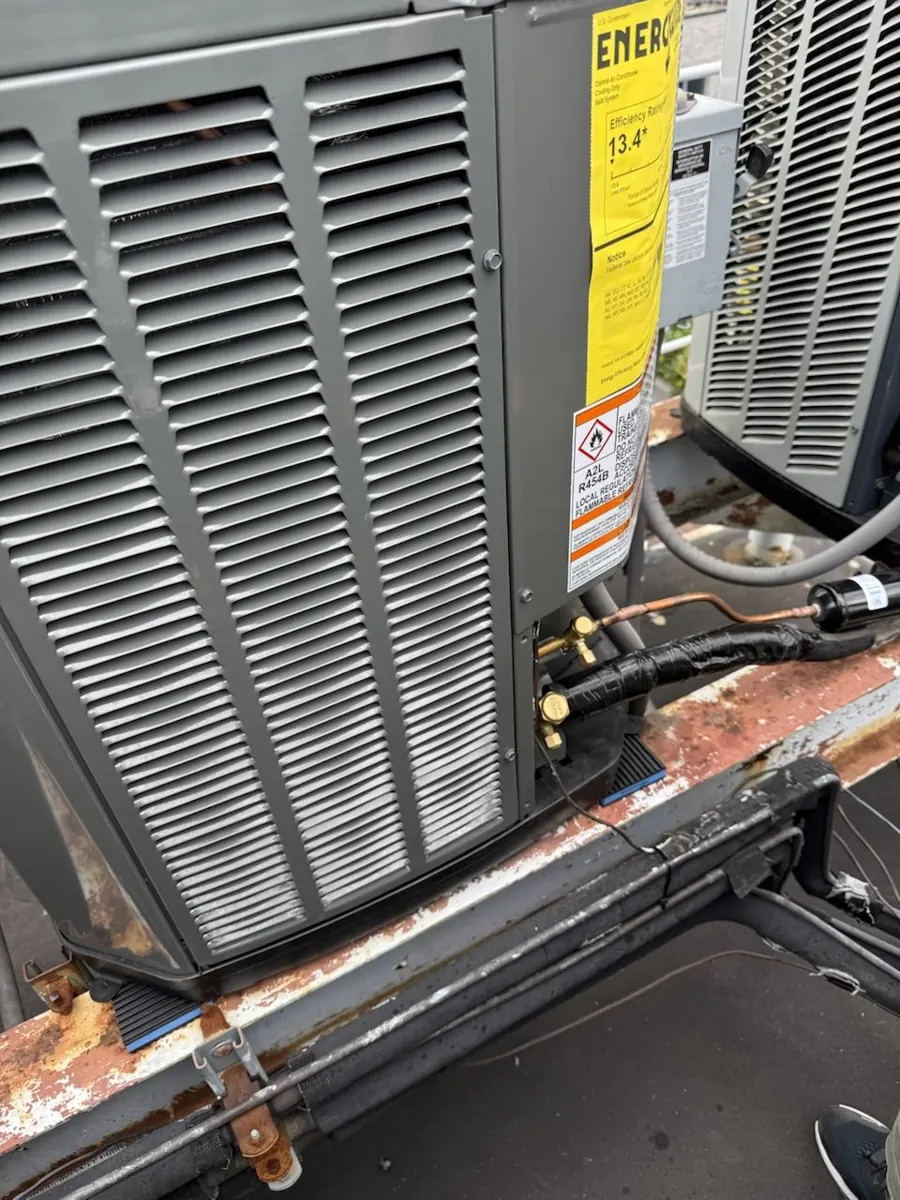
The yellow EnergyGuide label on the outdoor unit shows the efficiency rating range for that product category and where the unit falls. It is a useful sanity check, but it describes the outdoor unit's rating range, not necessarily your exact matched system. The AHRI certificate is the more precise document.
Variable-speed vs single-stage
Efficiency ratings track closely with compressor type:
- Single-stage compressors run at one speed: full on or off. They are simple and less expensive, but they cycle more, have lower SEER2 and offer less precise humidity and temperature control.
- Two-stage compressors have a low and high setting. They run on low most of the time and step up on hot days.
- Variable-speed (inverter) compressors adjust continuously. They run long, slow cycles at low power on mild days and ramp up for heat waves. This is how most ductless mini splits and premium central systems work, and it is why they earn high SEER2 ratings.
Variable-speed equipment also tends to be quieter, keeps temperatures more even, and handles the wide swings between a cool coastal morning and a hot afternoon better. For a deeper look at system types, see mini split vs central air and ducted vs ductless heat pumps.
When paying for higher SEER2 makes sense in LA vs coastal areas
Higher efficiency costs more up front. Whether it pays off depends mostly on how many hours your system runs.
Higher efficiency usually makes sense when:
- You live in the San Fernando Valley, Burbank, Glendale or another hot inland area with long cooling seasons.
- You work from home or keep the house cooled during the day.
- You are replacing both heating and cooling with a heat pump, so the system runs year-round.
- Your rebate program requires a certain efficiency tier.
- You value quiet operation and even temperatures, which variable-speed equipment provides.
Mid-range efficiency may be enough when:
- You live near the coast in Santa Monica, Venice or parts of the Westside where AC runs fewer hours.
- The system serves a space used occasionally, like a guest room or studio.
- Budget matters more and the home has a short cooling season.
In between, homes in Beverly Hills, West Hollywood and the Hollywood Hills often fall in the middle: real summer heat and fall heat waves, but cooler nights. Proper sizing with a Manual J load calculation matters as much as the rating. An oversized high-SEER2 system that short cycles will not deliver its rated efficiency. See what size AC do I need for why.
Efficiency and rebates
Utility and state incentive programs often set minimum efficiency requirements, usually tied to SEER2, EER2 and HSPF2, and often require a valid AHRI reference for the installed combination. Heat pumps are the main focus of programs like TECH Clean California. Requirements and funding change, so check current program rules before deciding on a tier. The federal 25C tax credit expired for equipment placed in service after December 31, 2025; check with a tax professional for your situation. See our California heat pump rebates guide and rebates page.
How HVAC Installation LA handles this
Every quote we write includes exact model numbers for the matched system, so you can verify the SEER2, EER2 and HSPF2 yourself. We do a Manual J load calculation on every quote, and we often show efficiency tiers side by side so you can see what you get at each level. We pull the permit, handle Title 24 and HERS testing so the system actually performs to its rating, and file the utility rebate paperwork with LADWP, SCE, BWP or GWP when the equipment qualifies.
“Fast response, competitive pricing and very communicative. If you want to deal directly with a service technician, call Nick. Most other places will direct you to a call center that sub-contracts the work out.”
Iconica Recordings · Google review
We install central systems, heat pumps and mini splits from brands including Carrier, Trane, Lennox and Mitsubishi Electric. See AC installation and heat pump installation, serving Burbank, Studio City, Glendale and greater LA. Call (818) 230-4038 or request a free estimate.
Frequently Asked Questions
01What is SEER2?
SEER2 is the seasonal cooling efficiency rating for air conditioners and heat pumps, measured under the updated 2023 federal test procedure. Higher SEER2 means less electricity used for the same cooling over a typical season.
02Is SEER2 the same as SEER?
No. SEER2 uses a test with higher external static pressure that better reflects real ductwork, so the same equipment gets a lower SEER2 number than its old SEER number. Compare SEER2 to SEER2, never to an old SEER rating.
03Why does EER2 matter in California?
EER2 measures efficiency at a hot, fixed outdoor temperature, which is close to what the San Fernando Valley sees on summer afternoons. California is in the DOE Southwest region, which includes an EER2 requirement for central air conditioners.
04What does HSPF2 measure?
HSPF2 is the heating efficiency rating for heat pumps over a heating season. In mild Los Angeles winters it matters less than SEER2 and EER2, but it still helps compare heat pumps.
05How do I verify the efficiency of the system I am being quoted?
Ask for exact outdoor and indoor model numbers and look up the matched combination in the AHRI Directory. The AHRI certificate shows the rated SEER2, EER2 and HSPF2 for that specific pairing.
06Is a higher SEER2 system worth it in Los Angeles?
It depends on where you live and how much you run the system. Valley and inland homes with long cooling seasons often benefit from higher efficiency and variable-speed equipment, while mild coastal homes may see less return.